MDPK5050T2R2MM Specs Deep Dive: DCR, Isat & Ratings
The MDPK5050T2R2MM presents nominal inductance of 2.2 µH, typical DCR near 55 mΩ, rated current about 3.6 A and a saturation current around 4.1 A. These headline numbers drive conduction loss, thermal rise, and usable peak current in switch-mode designs, so interpreting them correctly is essential for converter efficiency and reliability. This analysis focuses on DCR, Isat and current/thermal ratings and how to apply them in realistic board-level designs.
1 — MDPK5050T2R2MM at a glance (Background)
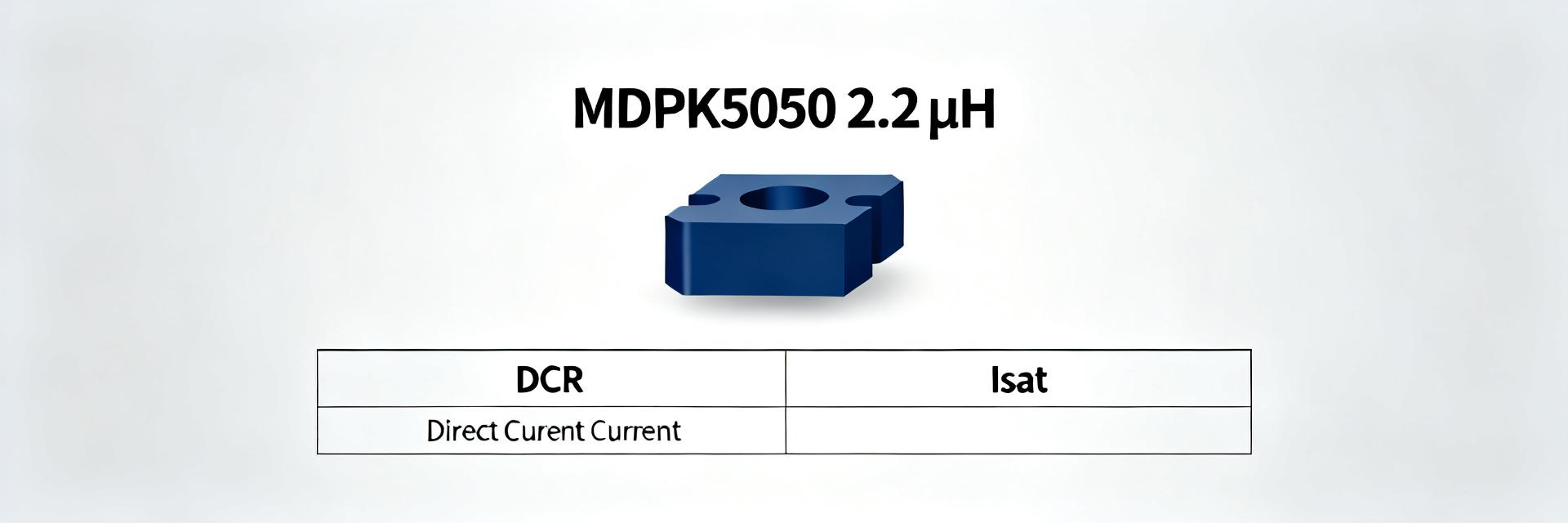
Spec summary table
| Parameter | Nominal | Typical range / notes |
|---|---|---|
| Inductance | 2.2 µH | ±20% tolerance typical |
| DCR (typ) | ≈55 mΩ | 40–80 mΩ depending on lot and temp |
| Rated current (Irated) | ≈3.6 A | Continuous current at specified ΔT |
| Saturation current (Isat) | ≈4.1 A | L drops by spec % at Isat (see curve) |
| Case size | 5050 SMD | Medium footprint, low profile |
| Core material | Powdered ferrite/compound | Optimized for switching freq 100 kHz–2 MHz |
| Test frequency | ~100 kHz | Measured L at low frequency; check L vs I curve |
Typical applications
Common uses include buck converters for point-of-load regulation, intermediate bus converters and high-density DC-DC modules where 2.2 µH balances ripple and transient response. The DCR and Isat make it appropriate for continuous currents up to about 3–3.6 A on well-cooled boards; operating frequencies from a few hundred kilohertz to low MHz are typical. Tight footprints favor this part where board real estate and thermal paths are constrained.
2 — Key specs breakdown: DCR, Isat & rated current (Data analysis)
What DCR tells you (and how to measure it)
Point: DCR directly sets I^2·R conduction loss and therefore steady-state efficiency.
Evidence: P_loss = I_rms^2 × DCR.
Explanation: measure with four-wire (Kelvin) method at ambient temperature; report DCR at 25°C and expect increases with temperature.
Example: at 3.0 A, a 55 mΩ part dissipates P = 3^2×0.055 = 0.495 W; an 80 mΩ alternative dissipates 0.72 W — a 46% higher conduction loss, which translates into measurable thermal and efficiency penalties.
Understanding Isat vs. Irated
Point: Isat indicates the current where inductance has fallen by a defined percentage (commonly 10–30%) and limits peak current capability; Irated is the continuous current allowed with acceptable temperature rise.
Evidence: L vs. I curves show the knee where L degrades.
Explanation: use Isat to check peak or surge currents in switching cycles; use Irated to size continuous thermal budget. For large peak-to-average ratios, verify both metrics against converter waveforms.
3 — DCR impact: thermal rise, efficiency and derating (Data & methods)
Loss and thermal modeling
Point: Combine I^2·R loss with a thermal resistance to estimate temperature rise. Evidence: ΔT ≈ P_loss × R_th (PCB+ambient path). Explanation: assume a conservative R_th_ambient of 40°C/W for a single-sided board and better for multi-layer with thermal vias. Sample table below shows P_loss and ΔT for DCR=55 mΩ at currents from 1.0 A to 3.6 A.
| Current (A) | P_loss (W) | ΔT @40°C/W (°C) |
|---|---|---|
| 1.0 | 0.055 | 2.2 |
| 2.0 | 0.22 | 8.8 |
| 3.0 | 0.495 | 19.8 |
| 3.6 | 0.7128 | 28.5 |
Practical derating guidelines
Point: Derate continuous current based on cooling and reliability targets. Evidence: many designs target operating current ≤70–80% of Irated to control ΔT and extend life. Explanation: pick ≤70% when airflow is poor or board thermal paths are limited; 80% is reasonable with copper pours, thermal vias and forced convection. Balance efficiency (lower DCR) versus size and magnetic saturation margins.
4 — Isat behavior under real waveforms (Method/guide)
Peak vs. RMS: what matters for Isat
Point: Isat limits peak current before inductance collapses; RMS determines heating. Evidence: triangular ripple RMS = ΔI/√12. Explanation: convert converter waveforms to equivalent peak and RMS components to compare to Isat and Irated. Example: a 2.0 A triangular ripple has RMS ≈0.577 A (if defined differently, use ΔI/√12), and the composite stress is peak relative to Isat and RMS relative to DCR losses.
How to test Isat on the bench
Point: Extract Isat from controlled L vs. I measurements. Evidence: use a current source or a power supply with series resistor, measure inductance at incremental DC bias currents. Explanation: step bias up while measuring L (L = V_AC / (2πf·I_AC)); identify current where L falls by the specified percent. Recommended setup: small AC injection at 100 kHz, Kelvin connections, incremental DC bias, thermal stabilization, and safety margin above measured knee.
5 — Thermal, EMI and layout considerations (Case-focused guidance)
PCB layout best practices
Point: Layout is the primary lever to control heating and EMI. Evidence: thermal vias, copper pours, and short high-current loops reduce ΔT and emissions. Explanation: place inductor close to the switching node; maximize copper under the part with thermal vias; shorten return paths; avoid routing sensitive traces near the switching node. Validate with IR camera scans and thermocouples during prototyping.
Filtering and EMI trade-offs
Point: Higher inductance improves filtering but can increase size or DCR; higher current parts typically have lower DCR but smaller L for same package. Evidence: insertion loss scales with L and series loss with DCR. Explanation: choose a lower-DCR, larger-current part when efficiency is prioritized; choose higher L if ripple or EMI attenuation is the primary goal and thermal budget allows.
6 — Selection checklist & application examples (Actionable)
Quick selection checklist
- Specify required L and tolerance for target ripple and transient response.
- Calculate peak and RMS currents from switching waveform; compare peak to Isat and RMS to Irated.
- Budget DCR for efficiency (compute I^2·R losses) and confirm PCB thermal path.
- Apply derating (70–80%) based on airflow and thermal vias; plan bench tests.
Two short application examples
Example A — 5 V to 1.2 V synchronous buck: Iout = 3.0 A, Fs = 500 kHz, assume ΔI ≈ 30% of Iout → ΔI = 0.9 A. Ripple RMS ≈ 0.9/√12 ≈ 0.26 A. Conduction loss at 3 A with 55 mΩ DCR ≈ 0.495 W; margin to Isat (4.1 A) is sufficient for transients but verify surge peaks. Layout: wide copper, thermal vias under the inductor.
Example B — Point-of-load module: Iout = 1.8 A, Fs = 300 kHz, target low EMI. ΔI assume 0.5 A → RMS ≈ 0.144 A. Loss at 1.8 A: P = 1.8^2×0.055 ≈ 0.178 W; thermal margin good on multi-layer board. Verify L vs. I to ensure transients do not reach knee region; check with IR camera and L measurements under bias.
Summary
- MDPK5050T2R2MM offers a pragmatic balance of 2.2 µH, moderate DCR and ≈3.6 A continuous rating, suitable for compact point-of-load designs with proper thermal planning.
- Derate continuous current to 70–80% of Irated when board cooling is limited; validate Isat with real switching waveforms rather than DC-only assumptions.
- Prioritize low DCR and PCB thermal paths for efficiency; always run L vs. I and thermal scans during prototype validation.
Call to action: validate the part in your converter with the outlined bench tests and layout checks before final qualification.
Frequently Asked Questions
How do I verify MDPK5050T2R2MM Isat on the bench?
Run a DC bias sweep while injecting a small AC test signal (e.g., 100 kHz) and record L at each bias. Identify the current where L drops by the defined percentage (often 10–30%). Ensure the inductor is thermally stabilized and use Kelvin leads for accuracy. Keep increments small around the expected knee.
How does DCR change with temperature and impact efficiency?
DCR increases with temperature typically following the conductor's temperature coefficient (~0.0039/°C for copper). Higher DCR increases I^2·R losses proportionally, so expected efficiency drops with elevated board temperature. Use thermal models and measure DCR at operating temperature for accurate loss budgeting.
What layout checks should I run when using this inductor?
Check copper pour under the inductor, the number and placement of thermal vias, loop area of the switching node, and proximity to sensitive traces. Validate with an IR camera under full load and with near-field EMI scans if EMI is critical. Iteratively refine placement and copper to meet thermal and emission targets.