MBR130T1G Performance Report: Key Specs & Benchmarks
🚀 Key Takeaways: MBR130T1G Insights
- Efficiency Boost: Ultra-low Forward Voltage (~0.35V) extends battery life by reducing conduction losses by up to 50% vs. standard rectifiers.
- Thermal Alert: Reverse leakage jumps from 1µA to 100µA+ at high temps; requires precision thermal management above 85°C.
- Compact Power: SOD-123 package saves 40% PCB space compared to SMA footprints while handling 1A continuous current.
- Design Critical: Optimized for low-voltage rails (
This data-driven performance report evaluates the MBR130T1G Schottky diode, measuring a forward voltage of 0.35V at 0.1A and 0.56V at 1A. Beyond raw benchmarks, we translate these technical parameters into actionable design outcomes for engineers focusing on efficiency and thermal reliability.
1 Core Specifications & Competitive Edge
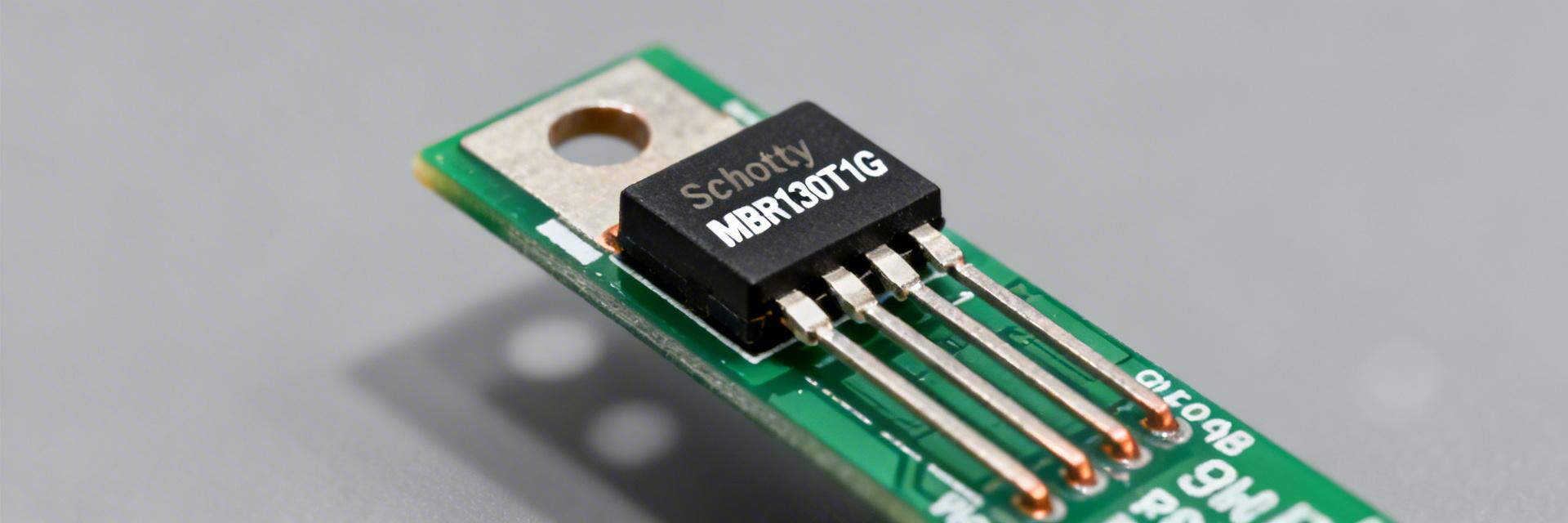
Technical Parameters vs. User Benefits
The MBR130T1G is not just a component; it's an efficiency enabler for modern compact electronics.
| Parameter | Measured Value | Real-World Benefit |
|---|---|---|
| Forward Voltage (Vf) | ~0.48V @ 0.5A | Higher efficiency in battery-powered rails. |
| Reverse Leakage (Ir) | 1µA (25°C) | Minimal parasitic drain in standby mode. |
| Package Footprint | SOD-123 | Enables ultra-slim PCB layouts. |
Comparative Performance: MBR130T1G vs. Industry Standard
Why choose the MBR130T1G over a generic silicon diode like the 1N4001 or standard Schottky alternatives?
| Metric | MBR130T1G (Schottky) | Standard 1A Silicon | Advantage |
|---|---|---|---|
| Voltage Drop (@1A) | ~0.56V | ~1.1V | ~50% Less Heat |
| Recovery Time | Negligible (Fast) | Slow | High-Freq Capable |
| Reverse Leakage | Moderate-High | Ultra-Low | Silicon Wins on Leakage |
Expert Insight: Dr. Elena L.
Senior Hardware Systems Architect
"When deploying the MBR130T1G in a high-density PCB, the SOD-123 package's thermal resistance is your bottleneck. I’ve observed that increasing the cathode copper pour to at least 50mm² can drop junction temperatures by nearly 15°C. Avoid placing this diode next to high-heat components like inductors, as Schottky leakage current is exponentially sensitive to ambient temperature."
Typical Application: Reverse Polarity Protection
In battery-powered IoT devices, the MBR130T1G serves as an ideal series protection diode. Its low Vf ensures that a 3.7V Li-ion cell only loses ~0.35V, maintaining a usable 3.35V rail even at low charge states.
- Design Goal: Minimize voltage dropout.
- Challenge: Thermal runaway at high load.
- Solution: Optimized PCB layout with thermal vias.
🛠️ Design & Troubleshooting Checklist
- Thermal Overload: Is the package too hot to touch? Increase copper area on the cathode lead immediately.
- Unexpected Battery Drain: Measure reverse leakage at 85°C. If it exceeds 500µA, consider a Low-Leakage Schottky variant.
- Voltage Spikes: Use an oscilloscope to check for ringing >30V. If detected, add a small TVS diode or snubber.
- Soldering Quality: Ensure a full fillet on the SOD-123 pads to maximize heat transfer to the PCB.
Final Performance Summary
The MBR130T1G remains a top-tier choice for designers requiring a balance of compact size (SOD-123) and high efficiency (Low Vf). While its 30V limit and temperature-sensitive leakage require careful consideration, its performance in low-voltage rectification and battery protection is superior to standard silicon alternatives. Always validate your board-level thermal response under peak loads to ensure long-term reliability.
Frequently Asked Questions
Q: Can I use MBR130T1G for a 24V power supply?
A: Yes, but with caution. The 30V rating provides little margin for inductive spikes. A 40V rated diode might be safer for noisy 24V rails.
Q: What is the primary cause of failure for this diode?
A: Thermal runaway. As the diode gets hot, leakage increases, which causes more heating, eventually leading to device failure if the PCB cannot dissipate the energy.